How Former Principal Ballerinas Train the Core Differently From Conventional Fitness
When most people think about core training, they imagine abdominal exercises: crunches, planks, sit-ups or high-intensity workouts designed to make the stomach feel as though it has been “worked.”
A professional ballet dancer thinks about the core differently.
For a ballerina, the core is not simply a group of abdominal muscles. It is the centre of control for almost everything the body does — from standing in perfect alignment to balancing on one leg, turning, jumping, changing direction and moving the arms with precision.
This is one of the reasons professional ballet training can create a very distinctive combination of strength, posture, balance and movement control.
At Ballet Body Sculpture, this principle is central to the way ballet-inspired training is approached: the goal is not simply to strengthen the abdominal muscles, but to teach the body to use the centre effectively while the rest of the body moves.
What does “core” actually mean?
The core is much more than the visible abdominal muscles.
It includes muscles and structures around the trunk and pelvis that contribute to stability and movement control, including the abdominal wall, deep trunk muscles, back muscles and muscles involved in pelvic and spinal control.
This matters because a strong core is not necessarily the same thing as a functional core.
You can have strong abdominal muscles and still struggle with posture, balance or controlling the pelvis while moving.
Ballet places very specific demands on the trunk because dancers frequently have to maintain control while the limbs move independently.
Research into dance training reflects this. A recent review of dance-training research found improvements in areas including trunk endurance, transversus abdominis activation, balance, coordination and hip strength, although the available research varies considerably between dance styles and programmes. (PubMed)
Ballet does not train the core in isolation
This is one of the biggest differences. In conventional abdominal training, the exercise may be the main event. In ballet, core control is integrated into movement.
Imagine a dancer standing on one leg while the other leg extends behind her. The challenge is not simply to “tighten the abs.”
She needs to coordinate:
the pelvis
spine
ribcage
supporting leg
hips
feet
arms
head and neck
—all while maintaining balance and moving with precision.
The core therefore becomes a dynamic stabiliser. This is very different from simply performing repetitions of an abdominal exercise.
The ballerina’s core must stabilise while the body moves
Professional dancers constantly work with the principle of:
stability + mobility + control.
The trunk needs enough stability to provide a strong centre, while the hips, shoulders, arms and legs remain free to move.
This is particularly important in movements involving:
développé
arabesque
attitude
turns
balances
port de bras
jumps
travelling movements
The stronger the relationship between the centre and the limbs, the more efficiently the body can move.
That is why ballet technique can make something as simple as standing look remarkably controlled.
Posture begins with the relationship between the ribs, pelvis and spine
Another important difference is that ballet does not treat posture as simply “pull your shoulders back.”
Good posture is an organised relationship between different parts of the body.
The position of the pelvis influences the spine.
The ribcage influences the position of the upper body.
The head and neck respond to the alignment below them.
And the feet and legs provide the foundation.
Core training therefore becomes closely connected with postural awareness.
Instead of repeatedly forcing the shoulders backwards, the dancer learns to organise the entire body.
Why Pilates fits so naturally into ballet training
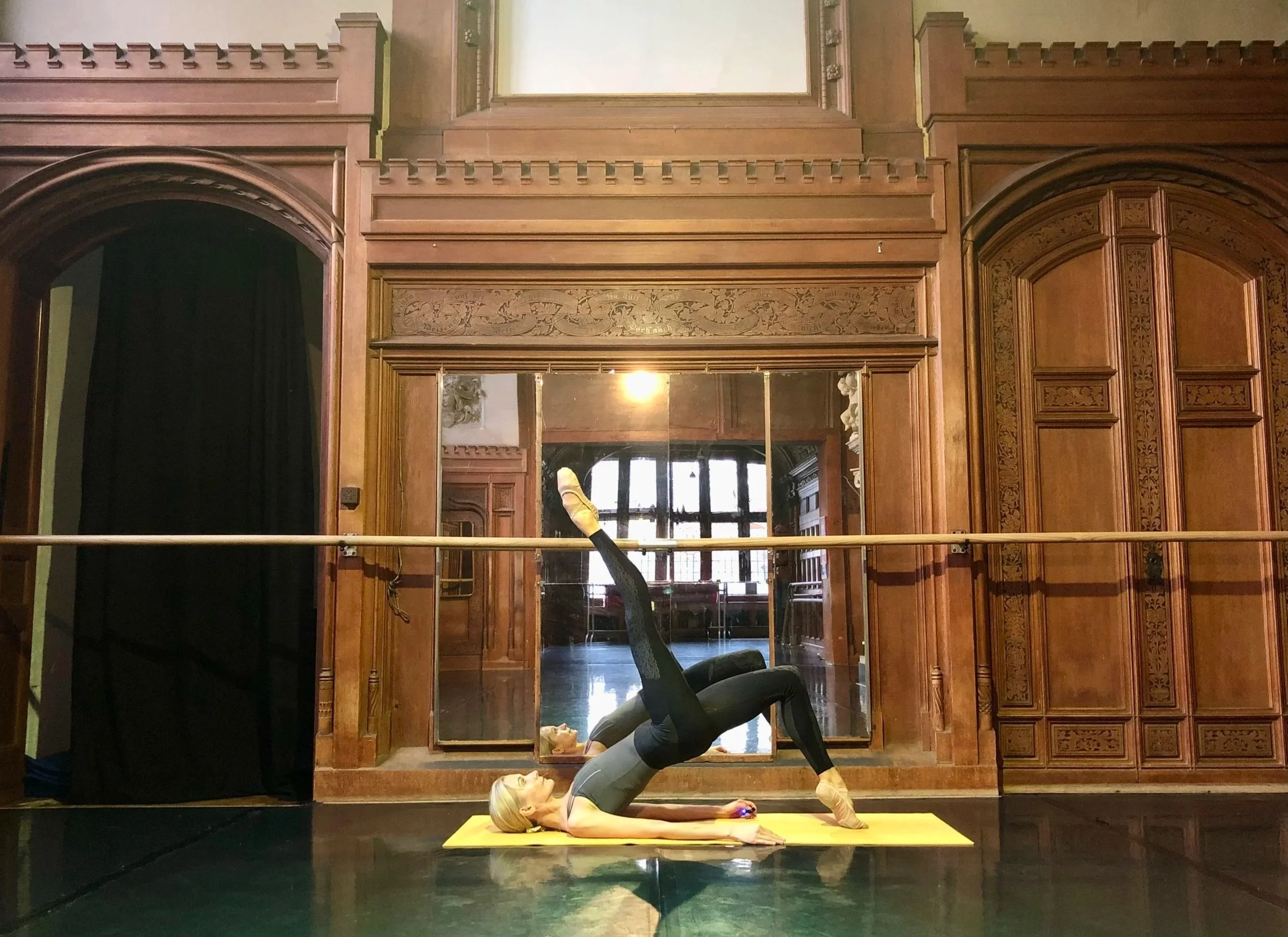
This is also where Pilates becomes particularly valuable.
Pilates places emphasis on core stability, muscle control, precision, breathing and posture. A systematic review of Pilates research describes these principles as central characteristics of the method. (PubMed)
Research has also found potential benefits for core muscle strength and activation, although results vary depending on the population and programme used. (PubMed)
For dancers, Pilates can therefore complement ballet by developing the control needed to execute movement efficiently.
One study involving young dancers found that adding Pilates to dance training improved postural alignment, flexibility and lower abdominal strength. (PubMed)
The goal isn’t to “burn” the core
This is perhaps the biggest mindset difference.
A ballet-trained approach does not necessarily ask:
“How exhausted can I make my abs?”
It asks:
“Can I control my centre while everything else moves?”
That distinction is important.
A dancer may need to hold a position for only a few seconds — but those few seconds require precise coordination between the trunk, pelvis, legs and feet.
The result is not simply muscular endurance.
It is movement intelligence.
How Ballet Body Sculpture approaches core training
The Ballet Body Sculpture Method combines elements of:
Ballet → posture, alignment, coordination and graceful movement
Pilates → core control, stability and precision
Body conditioning → strength and muscular endurance
Mobility → freedom of movement
Stretching → flexibility and body awareness
The purpose is not to turn everyone into a professional ballerina.
It is to take the principles that make ballet training so effective for movement quality and adapt them for the modern body.
You don’t need pointe shoes.
You don’t need years of ballet training.
And you don’t need to perform hundreds of crunches.
You need to learn how to connect the centre of the body with the way you stand, walk and move.
The result is more than a stronger stomach
A well-trained core can contribute to much more than abdominal strength.
It can support:
better postural control
balance
movement efficiency
body awareness
stability during movement
greater control of the pelvis and spine
more precise movement
This is why ballet-inspired core training can feel so different from a conventional “ab workout.”
The objective is not simply to build a stronger core.
It is to build a more intelligent relationship with your body.
Train your centre. Change the way you move.
At Ballet Body Sculpture, ballet technique meets Pilates-based core control and functional conditioning to create a sophisticated approach to fitness for adults.
You don’t have to become a ballerina.
You can simply learn to move like one.
Explore the Ballet Body Sculpture Method →